

Donor Tissue Counseling
Eggs or embryos? Start with a clearer picture.
There’s no single right way to preserve your fertility. These calculators use Spring’s clinical outcomes and the best available evidence to help you compare your options, develop realistic expectations and make a more informed decision about what feels right for your future.
Egg Freezing Estimate Calculator
EXPECTED OUTCOME
Based on Three Published Data Sets
AT LEAST
1 CHILD:
1 CHILD:
2 OR MORE
CHILDREN:
CHILDREN:
SPRING’s Estimated Results:
(13,533 warmed eggs)
AT LEAST
1 CHILD:
1 CHILD:
2 OR MORE
CHILDREN:
CHILDREN:
Doyle and Colleagues
(1,283 warmed eggs)
AT LEAST
1 CHILD:
1 CHILD:
2 OR MORE
CHILDREN:
CHILDREN:
Cobo and Colleagues
(1,513 warmed eggs)
AT LEAST
1 CHILD:
1 CHILD:
2 OR MORE
CHILDREN:
CHILDREN:
Result Info
Data sources:
This Frozen Egg Probability Calculator uses data from two published studies, as well as data published by Spring Fertility. As new data are made available, we will update our calculator regularly to better help you make informed decisions with the best and most recent evidence available. NOTE: All three data sources come from centers with significant experience in egg freezing. Egg freezing is arguably the most technically challenging procedure performed in the IVF lab and is still performed by hand. Every lab has their own unique approaches, even when using the same protocol. We suggest you speak with your IVF center to understand their unique:
- Survival rate of warmed eggs.
- Fertilization rate of both fresh and frozen eggs.
- Progression rate from fertilized eggs to blastocyst stage embryos.
- Probability that your embryos are chromosomally normal. While this depends primarily on age at which your eggs are ovulated, age-specific rates may also vary from practice to practice (and even physician to physician).
- Live birth rate per chromosomally normal embryo.
By combining these data points, you can produce a realistic and IVF center-specific probability of having a baby.
Using this Probability Calculator. We created this tool for patients who want to better understand the likelihood of having a baby from their frozen eggs. It is also intended to help women who are deciding if egg freezing is right for them. By adjusting your input numbers, you will be able to evaluate the potential benefit and limitations of freezing your eggs. It’s important for your physician to provide a reasonably accurate assessment of the number of mature (usable) eggs that you should expect after your initial fertility consult (this number is typically between 50-100% of your antral follicle count).
Our Commitment. We will continue to update and publish our internal data and we will update the published studies and data as more become available. For now, the consistency of the Cobo et al. and Doyle et al. studies provides a good indicator of chances for success, particularly among women freezing their eggs before their 38th birthday.
Spring’s Estimated Results
The Spring Fertility data uses the same method as Study B (by Doyle and colleagues). However, since most of the blastocysts we transfer have been previously tested for number of chromosomes, we assess the likelihood of obtaining a “chromosomally normal” blastocyst, rather than simply an untested blastocyst.
At Spring Fertility, we update our numbers every quarter based on the available data. This data set is representative of eggs thawed by December June 1, 2026.
- First, we evaluate the chance that a frozen egg will make it to a blastocyst stage embryo after warming – currently 32%. These data include 13,533 warmed eggs. The critical inputs are below:
- Thaw survival rate: 92%
- Successfully warmed (viable) egg to blastocyst development rate (this number will depend on the fertilization rate and embryo development rate): *We do note some differences in these two numbers based on age at the time eggs were frozen:
- 35% of cryopreserved eggs “frozen” BEFORE a patient’s 35th birthday fertilize and develop to blastocyst.
- 31% of cryopreserved eggs “frozen” BETWEEN a patient’s 35th birthday and 38th birthday fertilize and develop to blastocyst.
- 27% of cryopreserved eggs “frozen” BETWEEN a patient’s 38th birthday and 41st birthday fertilize and develop to blastocyst.
- 16% of cryopreserved eggs “frozen” AFTER a patient’s 41st birthday fertilize and develop to blastocyst.
- Next, we estimate the percentage of these resulting blastocyst embryos that will be chromosomally normal (euploid) based on a woman’s age at the time her eggs are frozen.
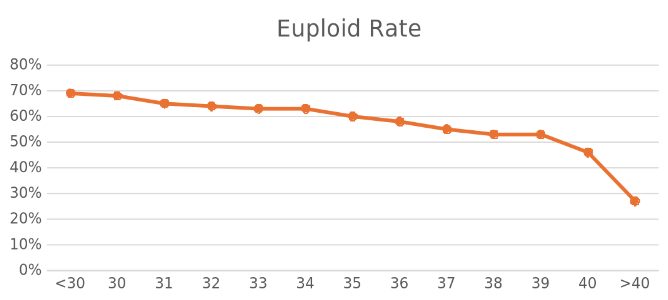
*Please keep in mind that these data vary from clinic to clinic and even physician to physician, so if you are not a Spring patient and are using this tool, we recommend that you inquire with your doctor/clinic to understand the rates that their patients experience.
3. Lastly, we input the live birth rate per transfer of a chromosomally normal embryo. This will depend on the success of your clinics cryopreservation and frozen embryo transfer protocols and implementation. This is not dependent on the age of the woman receiving the transferred embryo. At Spring this number is currently 63%.
Steps 2 and 3 can be eliminated and you can substitute the live birth rate per blastocyst if your center does not test many embryos before transferring them.
The resulting output from our data result in live birth rates per cryopreserved oocyte as follows:
| Spring estimated live birth probability | |||
| Maternal Age (years) | N = embryo samples with results | Euploid Rate (%) | Spring estimated efficiency* |
| <30 | 367 | 69% | 16.9% |
| 30 | 218 | 68% | 16.7% |
| 31 | 217 | 65% | 15.9% |
| 32 | 423 | 64% | 15.7% |
| 33 | 421 | 63% | 15.4% |
| 34 | 590 | 63% | 15.4% |
| 35 | 564 | 60% | 13.0% |
| 36 | 381 | 58% | 12.6% |
| 37 | 330 | 55% | 11.9% |
| 38 | 233 | 53% | 10.0% |
| 39 | 194 | 53% | 10.0% |
| 40 | 65 | 46% | 8.7% |
| >40 | 59 | 27% | 3.0% |
Study B: Doyle and Colleagues’ Results
Doyle and colleagues have reported the next largest data set to date, including live birth rates after warming 1,283 vitrified and subsequently warmed eggs between 2009 and 2015. This is one of the largest published data sets available. While not every embryo created from these frozen eggs was transferred, the authors estimated the live birth rates as if every viable blastocyst stage embryo was transferred. As a proxy for older patients who had fewer embryos, they used their success rates from their IVF outcomes – they had previously demonstrated that blastocyst stage embryos from frozen eggs had at least as high a pregnancy and live birth rate as blastocyst stage embryos from women of the same age using fresh, never frozen eggs. Their published outcomes involved the below calculations:
- Calculate the number of live births from frozen eggs from women at various ages.
- They still had embryos (blastocysts) remaining from the frozen eggs that were not transferred and refrozen, so they estimated how many of those frozen blastocyst embryos would result in a live birth based on their experience with blastocyst stage embryos frozen from women of the same age (at the time the eggs were retrieved). This estimate allowed them to approximate the efficiency per egg.
- Since this number looked unrealistically high for women at age 41-42, they substituted the efficinecy of live birth per fresh oocyte at this age and applied this number to the eggs that survived freezing/warming.
This study lacked extensive data on eggs frozen from women who are older than 37 (only 96 eggs). The 96 warmed eggs from women over age 37 yielded 5 babies. These numbers gave an unusually high efficiency for women over age 37 so the authors correctly adjusted their data to “predict” the efficiency using:
- Their survival rate for frozen eggs.
- The anticipated number of blastocysts that would develop from those eggs.
- Their live birth rates using blastocysts derived from fresh (non-frozen eggs) at each age group.
They then assumed a binomial “normal” distribution to yield the predicted probability per frozen oocyte at each age group. Our calculator uses the same assumption (a binomial distribution) to arrive at the probability of 1 or multiple children based on the number of eggs and the probability of a live birth per egg.
They arrived at the following estimates for live birth efficiency per egg:
| Doyle et al 1,283 warmed eggs | |
| <30 | 8.2% |
| <35 | 8.0% |
| 35-37 | 7.3% |
| 38-40 | 4.5% |
| 41-42 | 2.5% |
Study A: Cobo and Colleagues’ Results
Cobo and colleagues is the largest data set of published outcomes from frozen/warmed oocytes. This study simply reported on the live birth rate per warmed egg in women of each age group. We entered these estimates into a binomial calculator to arrive at the chances of having 1 or multiple live births based on the number of eggs used in each age group.
Interesting additional information: the majority of these eggs were not tested for chromosome number. This study further reports no difference in outcomes based on amount of time samples were frozen (up to five years). 90.4% of warmed eggs survived the thaw and 1.4% of warming cycles had no eggs survive. These data yielded the following outcomes (the number of eggs included is represented on the right column).
| Cobo and colleagues estimated efficiency (1,513 warmed eggs) | Number of eggs | |
| < 35 | 6.6% | 697 |
| 36-37 | 6.1% | 312 |
| 38-39 | 5.6% | 284 |
| >40 | 1.8% | 220 |
Considering freezing eggs?
Explore your likelihood of success per egg based on Spring’s IVF outcomes and your individual circumstances.
Personalized IVF Calculator
Considering freezing embryos?
Estimate your chance of having 1 or more children based on your age when your eggs are frozen and the number you freeze.
Clarity for
what’s ahead
The financial side of fertility care can feel overwhelming, especially when you’re already carrying so much. You deserve clear, compassionate guidance to help you understand costs, navigate insurance, and explore your options with greater confidence.