
Donor Tissue Counseling
Personalized Fertility Treatment
There is no single fertility treatment or IVF protocol that is best for every patient.
Fertility treatment is personal by nature. Your biology, reproductive history, goals, and circumstances are your own. We believe your care should be too.

Personalized Treatment. Personalized Experience.
At Spring, personalized care means two things:
Personalized Treatment
There is no single “best” protocol for every individual or every couple. Your physician considers your biology, ovarian reserve, sperm factors, reproductive history, previous treatment and response, goals, and other clinical factors to determine what makes sense for you.
That can mean selecting a different stimulation protocol, individualizing medication or dose, adjusting treatment based on response, choosing between fresh and frozen embryo transfer, considering egg or embryo banking, or determining which genetic testing strategy is appropriate.
Personalized Experience
You should never feel like a number. We want you to know who is caring for you, understand why important decisions are being made, and feel that your individual circumstances and experience matter throughout treatment.
Clinical effectiveness and safety come first, but when more than one clinically appropriate path exists, treatment burden, circumstances, and experience matter too.
Two patients can have the same diagnosis and still benefit from different treatment plans.
That’s because a diagnosis is only one piece of the clinical picture. Depending on the decision being made, your physician may consider your age, ovarian reserve, reproductive history, hormone levels, previous treatment and response, sperm factors, genetic considerations, family-building goals, and individual risks.

What Makes Fertility Treatment Personal?
Depending on the decision being made, your physician weighs a combination of factors together — not a single data point, but a full clinical picture.

BIOLOGY
Ovarian reserve,
hormone levels,
sperm factors
HISTORY
Reproductive history & previous treatment
TREATMENT RESPONSE
How your body responds as care unfolds
GOALS
Family-building
goals & priorities
CIRCUMSTANCES
Timing, burden, and
individual risks
And personalization continues as treatment unfolds. Monitoring provides new information about how your body is actually responding, allowing the plan to adapt when clinically appropriate.
The goal isn’t to make everyone’s treatment different. It’s to make every treatment decision intentionally for the patient in front of us.
Sometimes the easiest way to understand personalized care is to see it in practice. Explore real and representative examples of how individual biology, treatment response, goals, and circumstances can change the decisions Spring physicians make.


Fewer Injections, When Clinically Appropriate
When Meghan returned to Spring for an IVF cycle with PGT-M and concurrent egg thaw four years after freezing her eggs, Dr. Gayathree Murugappan determined that an alternative medication approach was appropriate for her. The result: significantly fewer injections and a lighter treatment burden without changing the clinical objective.
IN PRACTICE
Same Diagnosis.
Different Treatment Plans
A diagnosis doesn’t dictate a protocol. See how differences in ovarian reserve, reproductive history, previous response, or family-building goals can lead physicians to recommend different approaches.

Why More Medication Isn’t Always Better
For some patients, minimal stimulation may be clinically appropriate and make more sense than a conventional higher-intensity approach.

When Your Response Changes the Plan
Monitoring shows your physician how your body is actually responding, allowing medication, timing, and other elements of treatment to change when clinically appropriate.

Why IVF Can Look Different With PCOS
PCOS can influence ovarian response and decisions around medication, dosing, monitoring, and safety. The diagnosis matters, but it doesn’t dictate a single treatment protocol.

Fresh or Frozen? It Depends on the Patient
Treatment response, hormone levels, embryo testing plans, and other clinical factors can influence whether a fresh or frozen embryo transfer makes more sense.

When Male Factor Changes the IVF Strategy
Sperm factors and previous fertilization outcomes can influence how fertilization is approached during IVF, including decisions around conventional insemination and ICSI.

When Personalized Egg Freezing Means Fewer Injections
When multiple approaches are clinically appropriate, a personalized medication strategy may reduce the number of injections without changing the treatment goal.

Same Diagnosis. Different Treatment Plans.
Patients with the same diagnosis may have different ovarian reserve, treatment history, responses, and goals—leading physicians to recommend different approaches.
OUTCOMES COME FIRST
Personalization doesn’t mean choosing the easiest treatment, adding more interventions, or simply doing whatever a patient prefers.
Clinical effectiveness and safety guide treatment decisions.
Sometimes the standard approach is exactly the right approach. Sometimes information about the patient points toward an alternative. And sometimes more than one evidence-based option is clinically appropriate, allowing treatment burden, circumstances, or experience to become part of the decision.
Personalization requires both options and the expertise to understand when those options are appropriate.
PERSONALIZED BY DATA, GUIDED BY PHYSICIANS

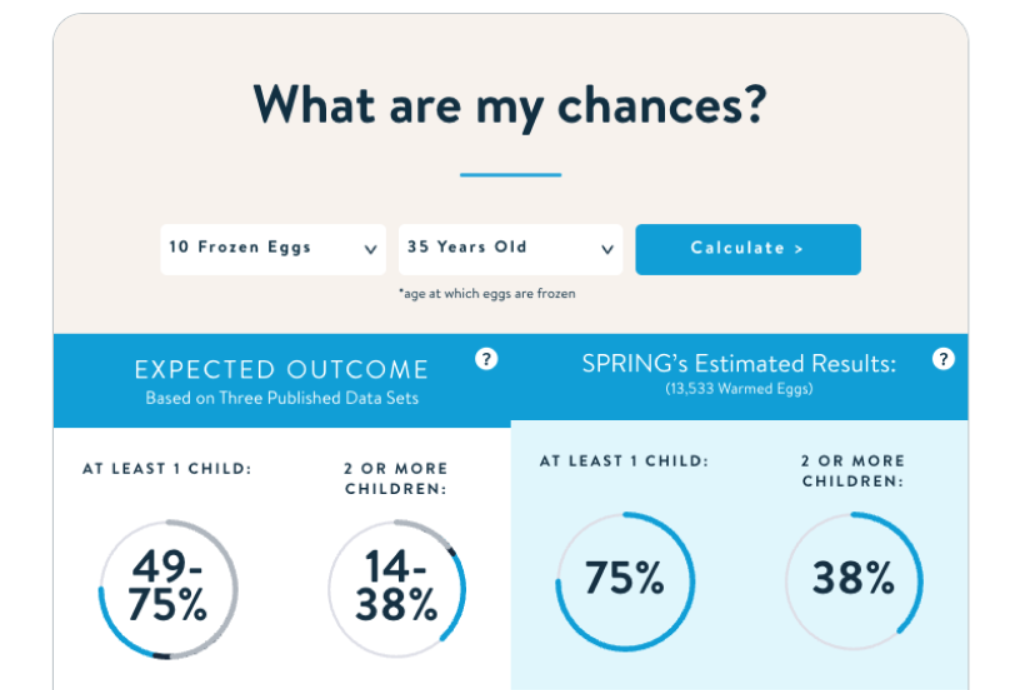
It considers individual factors to help estimate potential outcomes and provide a more personalized starting point for conversations about treatment. But data doesn’t replace clinical judgment. Your physician brings together the available evidence, your individual clinical picture, and what we learn during treatment to determine what makes sense for you.
Let’s Talk About What’s Right for You
Personalized care isn’t a promise that your treatment will be different. It’s a commitment that your treatment won’t be chosen simply because it’s what we do for everyone.
Sometimes personalization means a different protocol. Sometimes it means changing course because your response tells us something new. Sometimes it means reducing an unnecessary treatment burden. And sometimes it means knowing that the standard approach is the right one. At Spring, personalized care means personalizing the treatment—and the experience of going through it.
Your diagnosis is part of your story, but it isn’t the whole story. Meet with a Spring Fertility physician to discuss your history, goals, and individual clinical picture — and what they may mean for your treatment.
Or call (415) 964-5618